8 Key Advantages of a Data Warehouse for Better Decision-Making, Reporting, and Analytics
Keith Cutajar, COO, Data Engineering Expert
May 13, 2025
Updated:May 20, 2026
Understanding the advantages of a data warehouse is essential for any organisation struggling with fragmented systems, slow reporting, or mounting compliance demands. A modern data warehouse centralises data from across your CRM, ERP, and other sources, eliminating duplication and giving teams one reliable version of the truth. This article covers eight key benefits, from unified data and improved quality through to advanced analytics, cost efficiency, and seamless cloud integration, using Eunoia’s work with Gordian Holdings as a real-world example that achieved 20% higher operational efficiency and 30% faster decision-making.
In a business climate where speed and precision drive competitiveness, reliable data is your edge. And yet, many organisations still operate with fragmented systems, inconsistent metrics, and reporting processes that slow decision-making.
A modern data warehouse changes that. It centralises your data, eliminates duplication, and makes it accessible, giving your teams one version of the truth and the tools to act on it quickly.
This article explores the key advantages of a data warehouse, grounded in real implementation experience, and why it’s become a cornerstone for better analytics, compliance, and operational scale.
A data warehouse is a central repository that consolidates structured and semi-structured data from multiple sources, such as CRMs, ERPs, spreadsheets, and APIs, and prepares it for analysis and reporting. It stores historical and current data in one place, optimised for analytical queries rather than daily transactions.
By consolidating information into a single location, a data warehouse eliminates the need for manual data extraction, spreadsheet merging, or jumping between systems to access insights. This unification is particularly valuable for businesses that have grown through acquisitions or operate across multiple departments and markets, each using its own tools.
The architecture of a data warehouse is designed for high-performance querying, meaning users can access historical data quickly, run complex calculations, and create dashboards or reports without slowing down operational systems.
A well-implemented data warehouse lays the foundation for a modern data platform, enabling the integration of AI, machine learning models, and advanced forecasting tools.
IBM explains that the purpose of a data warehouse is to support business intelligence and advanced analytics by aggregating data across the organisation into a format that enables fast, consistent insights.
8 Key Advantages of a Data Warehouse
1. Unified Data from Multiple Sources
Data fragmentation is more than a technical problem, it’s a business blocker. Sales lives in your CRM, financials in the ERP, and key metrics in siloed spreadsheets.
This is where first-hand experience matters. At Eunoia, we led a major data centralisation project for Gordian Holdings, a regulated investor in Cyprus. Prior to implementation, their performance and regulatory data was distributed across multiple servicing systems. Teams were spending hours reconciling numbers across tools.
By building a centralised data warehouse, we gave them a unified, live view of their portfolio, with automated daily data ingestion and Power BI dashboards for drill-down analysis. This kind of unified architecture is essential for reliable, cross-functional reporting.
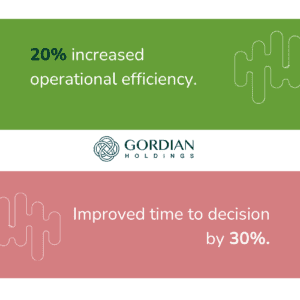
Result: 20% higher operational efficiency and 30% faster decision-making.
2. Faster and More Accurate Reporting
Manual reporting creates delays and introduces risk. With data scattered and inconsistent, building a report often means chasing inputs, checking accuracy, and cleaning up errors.
Data warehouses automate that process. With standardised pipelines and validated models, reports can be generated in minutes, not days.
Gordian Holdings cut their reporting time dramatically by moving from manual spreadsheets to automated reporting pipelines. This shift enables business teams to make timely, confident decisions based on accurate information.
3. Improved Data Quality
Bad data leads to bad decisions, inconsistencies, missing values, and duplicates eroding trust.
One of the key advantages of a data warehouse is its ability to enforce consistency through data modelling, validation rules, and transformation logic.
Gordian eliminated discrepancies across departments by consolidating portfolio data under a single model. This is backed by Informatica, which notes that warehouses provide the infrastructure needed to ensure quality across enterprise analytics.
Before selecting a data model, organisations benefit from a data readiness assessment to identify quality gaps early and prioritise remediation.
4. Scalability for Growing Data Volumes
Data volume is only moving in one direction, up. Each new customer, region, or product adds complexity to your reporting needs.
Cloud-native data warehouses are built to scale, allowing businesses to handle high-volume workloads without re-engineering.
Gordian scaled seamlessly to onboard additional portfolios without compromising performance.
5. Enhanced Security and Compliance
Regulated businesses need control, not just access. With role-based permissions, encryption, and full audit trails, a data warehouse gives IT teams the tools to enforce governance and meet compliance standards like GDPR.
Gordian Holdings, operating under the oversight of the Central Bank of Cyprus, transitioned from manual regulatory tape generation to daily automated compliance reporting.
This kind of automation is key to meeting modern audit and data privacy requirements.
6. Advanced Analytics and Predictive Insights
A well-designed warehouse becomes the launchpad for advanced analytics, – from Power BI dashboards to AI-powered forecasts.
Gordian used their centralised platform to deliver near real-time analytics to business users, enabling faster interventions and smarter decision-making.
IBM notes that warehouses are the gateway to machine learning and predictive modelling, allowing businesses to act on patterns rather than just react to outcomes.
For teams weighing their architecture options, our comparison of data lakehouse vs. data warehouse sets out the key decision criteria based on AI and ML requirements.
7. Cost Efficiency
Manual reporting isn’t just slow, it’s expensive. Time lost, errors made, and duplicated effort all add to overhead.
While setting up a data warehouse requires investment, it quickly pays for itself in operational savings. Automated pipelines, better reporting, and reduced IT support free up resources across the board.
Gordian’s warehouse eliminated spreadsheet chaos, and reduced reporting overhead with clean, reusable data models.
8. Seamless Cloud Integration
Today’s architecture is hybrid by default. Businesses need to connect legacy systems with modern cloud tools, without breaking the data model.
Modern data warehouses integrate easily with cloud storage (like Azure Data Lake or AWS S3), SaaS platforms, and APIs.
Gordian combined on-prem servicing systems with modern cloud pipelines to support analytics, compliance, and reporting. According to AWS, this interoperability is essential for keeping infrastructure agile and future ready.

Advantages and Disadvantages of a Data Warehouse
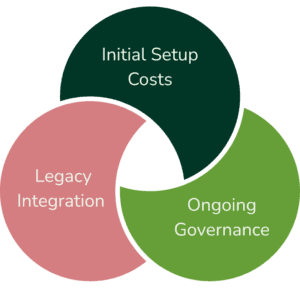
No system is without trade-offs. While the advantages of a data warehouse are clear, it’s important to acknowledge the challenges:
Initial Setup Costs. Requires investment in planning, design, and infrastructure.
Legacy Integration. Connecting older systems can demand time and custom development.
Governance Overhead. Warehouses require continuous maintenance to stay reliable.
That said, for most growing businesses, the advantages and disadvantages of data warehouse projects are clear-cut: the upside far outweighs the complexity.
Gordian Holdings' Success Story: A Real-World Example
Gordian Holdings is a market-leading investor in secured debt and real estate portfolios across Cyprus. With data fragmented across multiple platforms, they faced mounting pressure to streamline reporting, meet compliance demands, and support growth.
We helped them implement a centralised data warehouse that:
Consolidated portfolio data into one platform
Enabled Power BI dashboards with drill-down capability
Automated daily regulatory reporting
Delivered 20% increase in operational efficiency and 30% faster decisions
Their story proves that the right foundation, built with the right partner, delivers measurable business impact. Read the full case study.
How to Get Started with a Data Warehouse
If you’re considering investing in a data warehouse, here’s where to start:
Assess your data landscape: What systems are you using? What reports take too long?
Clarify your goals: Faster reporting? Regulatory compliance? AI readiness?
Choose the right architecture: Microsoft Fabric, Azure, Databricks, Snowflake
Partner with experts: Implementation quality is what determines long-term ROI.
The advantages of a data warehouse are no longer hypothetical, they’re proven. From unified reporting to predictive analytics, the benefits show up fast when architecture and execution align.
As Gordian’s success demonstrates, a modern data warehouse helps with more than just storage. It’s about using data to run smarter, faster, and more confidently.
See how we helped Gordian Holdings achieve 20% higher operational efficiency.
The key advantages of a data warehouse include unified data from multiple sources, faster and more accurate reporting, improved data quality, scalability for growing data volumes, enhanced security and compliance, the ability to support advanced analytics and predictive insights, cost efficiency through automation, and seamless cloud integration. As demonstrated by the Gordian Holdings implementation, a well-built warehouse can deliver measurable results, including 20% higher operational efficiency and 30% faster decision-making.
What is a data warehouse and what is it used for?
A data warehouse is a central repository that consolidates structured and semi-structured data from multiple sources, such as CRMs, ERPs, spreadsheets, and APIs, and prepares it for analysis and reporting. It is used for business intelligence, advanced analytics, compliance reporting, and performance dashboards. Unlike operational databases, a data warehouse is optimised for high-performance analytical queries, enabling users to access historical data quickly without slowing down transactional systems.
What are the disadvantages of a data warehouse?
The main disadvantages of a data warehouse include initial setup costs, the complexity of integrating legacy systems, and the ongoing governance overhead required to keep data reliable and up to date. For most growing businesses, however, these challenges are outweighed by the operational and analytical benefits, particularly when implementation is approached with a clear architecture plan and experienced delivery partners.
How does a data warehouse improve decision-making?
A data warehouse improves decision-making by giving every team access to a single, consistent version of the data, eliminating the need to reconcile conflicting reports from different systems. With standardised pipelines and validated data models, business leaders can access accurate, up-to-date information in minutes rather than days. The Gordian Holdings case study in this article illustrates how moving from manual spreadsheets to automated reporting pipelines directly enabled faster and more confident decisions at the leadership level.
What is the difference between a data warehouse and a data lake?
A data warehouse stores structured and semi-structured data that has been cleaned, modelled, and optimised for analytical queries. A data lake, by contrast, stores raw data in its native format, structured, semi-structured, or unstructured, and is better suited to exploratory analysis and machine learning workloads. A data lakehouse combines elements of both, offering the flexibility of a lake with the performance and governance of a warehouse. The right architecture depends on your current data maturity, use cases, and AI ambitions.
Keith Cutajar, COO, Data Engineering Expert
Author
Keith Cutajar is Chief Operating Officer and Data Engineering Expert at Eunoia, bringing over seven years of hands-on experience leading data and AI transformation projects, including data warehouse design and implementation for regulated enterprises.
He has overseen end-to-end implementations across cloud platforms like Azure and Databricks, with a focus on turning complex data systems into real business outcomes.
Keith holds multiple certifications in Microsoft Fabric, Azure, and Databricks, and has led cross-functional teams through platform migrations, AI deployments, and analytics modernisation initiatives. His track record positions him as a trusted voice for organisations looking to operationalise data at scale.
Manage Consent
To provide the best experiences, we use technologies like cookies to store and/or access device information. Consenting to these technologies will allow us to process data such as browsing behavior or unique IDs on this site. Not consenting or withdrawing consent, may adversely affect certain features and functions.
Functional
Always active
The technical storage or access is strictly necessary for the legitimate purpose of enabling the use of a specific service explicitly requested by the subscriber or user, or for the sole purpose of carrying out the transmission of a communication over an electronic communications network.
Preferences
The technical storage or access is necessary for the legitimate purpose of storing preferences that are not requested by the subscriber or user.
Statistics
The technical storage or access that is used exclusively for statistical purposes.The technical storage or access that is used exclusively for anonymous statistical purposes. Without a subpoena, voluntary compliance on the part of your Internet Service Provider, or additional records from a third party, information stored or retrieved for this purpose alone cannot usually be used to identify you.
Marketing
The technical storage or access is required to create user profiles to send advertising, or to track the user on a website or across several websites for similar marketing purposes.