








Modern Data Platform for Trusted Reporting and AI-Ready Innovation
A modern data foundation aligns your business and technical teams around a single source of truth, improving operations today and opening the door to tomorrow’s capabilities.

One Unified View of the Business
Standardised data flows, consistent logic, and a single source of truth that removes duplication and prevents conflicting numbers.

Faster, More Reliable Reporting
Improved accuracy and speed with standardised models, automated refreshes, and a consistent semantic layer aligned to your business definitions.

Ready for Analytics, ML, and AI
A scalable modern architecture that prepares your organisation for predictive analytics, advanced reporting, and AI workloads.
What This Service Includes
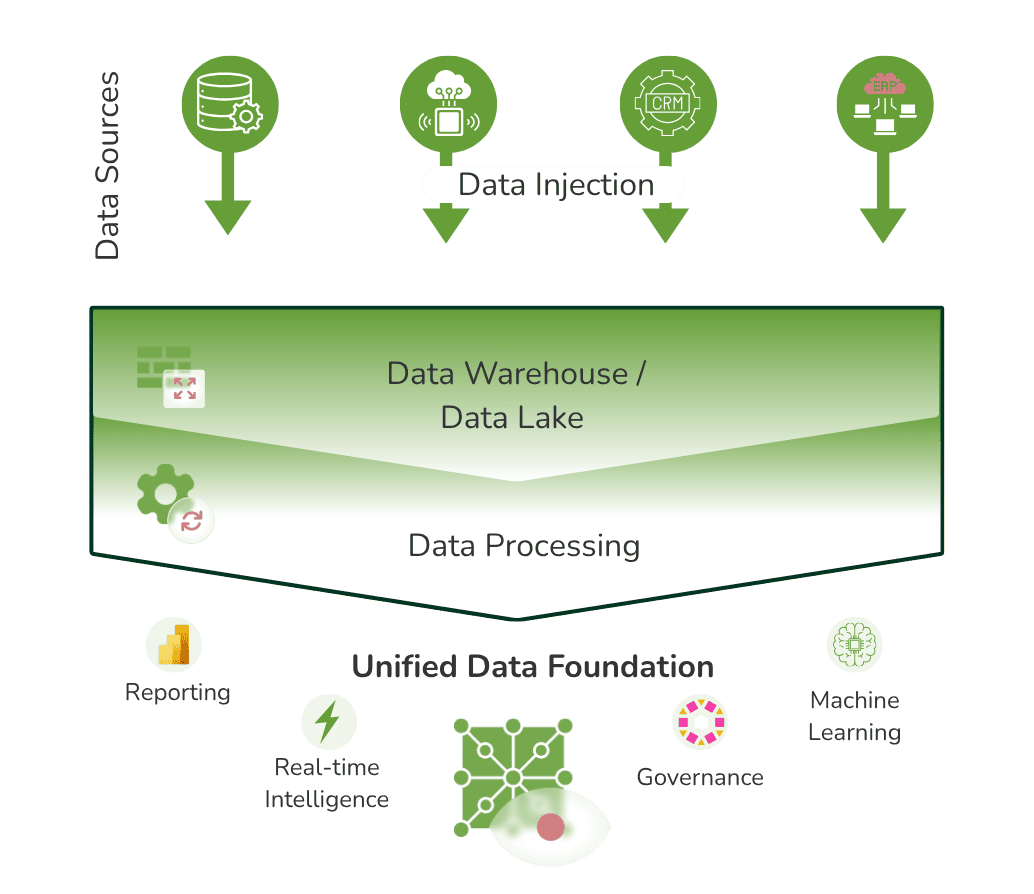
We build a modern data platform that unifies your systems, standardises your business logic, and ensures your organisation can trust the numbers it uses to make decisions.
Our service covers the full lifecycle – from strategy and architecture design to implementation, modelling, governance, and handover.
What we deliver:
• Architecture design
• Data ingestion and pipeline automation
• Storage and governance framework
• Data quality management
• Analytics and visualisation layers (Power BI and beyond)
How We Work
Why Choose Eunoia?
What Makes Our Approach Different?

Deep Microsoft and Databricks Expertise
We are Databricks and Microsoft partners, and Malta’s first Microsoft Analytics on Azure Specialisation partner — the highest level of Microsoft certification for data and analytics delivery.
Expert-Led Delivery
Senior engineers and architects lead every project from design to implementation, ensuring accuracy, continuity, and accountability.

Phased, Low-Risk Execution
We prove value early through controlled pilots and phased rollouts, de-risking transformation while delivering measurable outcomes fast.


Our Resources
Explore a range of insightful content that helps you better understand data and AI. Our collection includes informative blog posts, practical guides, and real-world case studies that cover key topics and trends.
Case Studies
Gordian Holdings’ Success Story: Enhancing Efficiency with Data Centralisation
Insurance Data Migration to a Cloud Solution for Atlas Insurance


Our Best Blog Content
Benefits of Data Governance: What Business Leaders Need to Know
7 Leading Data Governance Solutions for Enterprises in 2026

Get in Touch
Fill in the form, and we’ll reach out to you soon.
"*" indicates required fields


Frequently Asked Questions
What is a modern data platform?
A modern data platform is an integrated architecture that centralises data ingestion, storage, processing and analytics within a unified environment. It typically combines a data lake or warehouse with automated pipelines, governance controls and reporting tools.
Its purpose is to replace fragmented systems, manual reporting and inconsistent logic with a scalable, governed foundation.