

















ERP Data Migration That Protects Business Continuity
Our data migration services focus on continuity first, ensuring reporting and analytics remain reliable while systems change.

Continuous Reporting
Maintain uninterrupted access to dashboards and KPIs during ERP migration to avoid manual workarounds and keep making informed decisions throughout the transition.

Trusted, Consistent Data
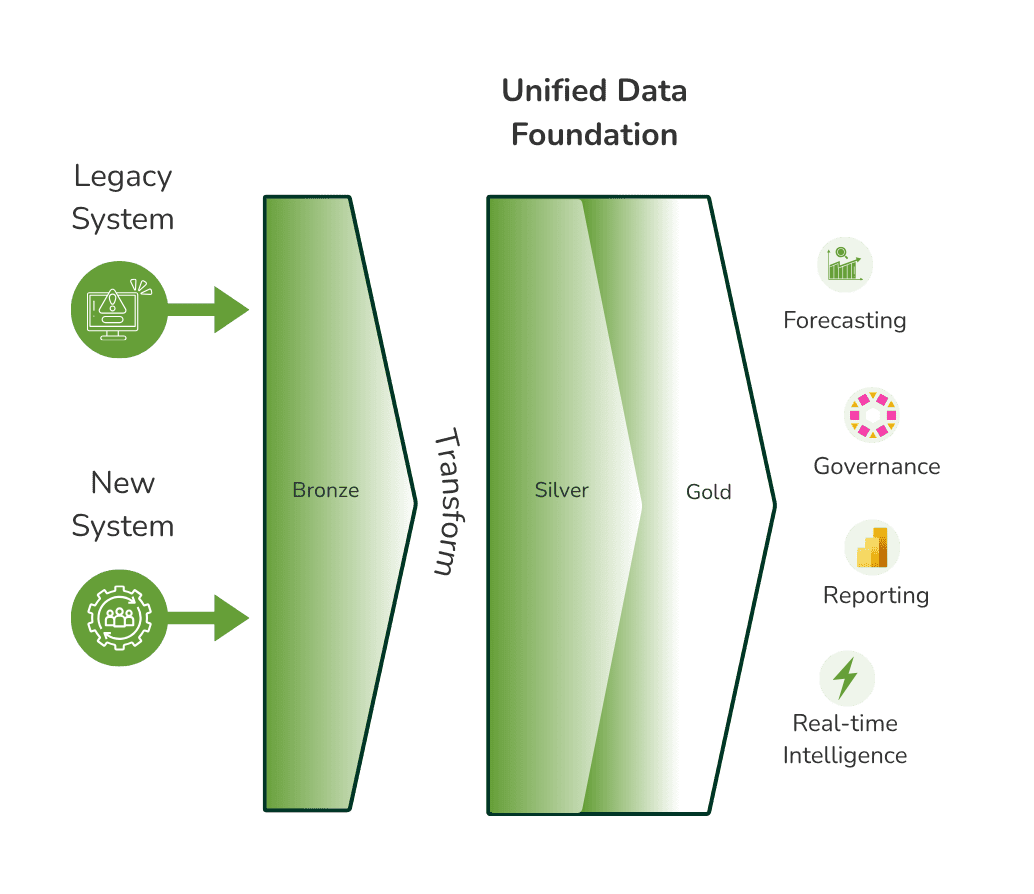
Reconcile legacy and new ERP data models into a single reporting layer. This eliminates conflicting numbers, reduces spreadsheet dependency, and maintains trust in reporting.

Future-Ready Data Foundation
Avoid short-term fixes that create long-term gaps. ERP data migration is delivered as part of a scalable data platform, preserving historical data and enabling analysis across years.
What the ERP Data Migration Service Includes
Our ERP data migration service is delivered as a platform-led, reporting-first engagement designed to protect business visibility during system change.
You get:
- A unified reporting layer connecting legacy and new ERP systems
- Aligned data models, KPIs, and definitions across systems
- Embedded governance and clear data ownership for consistency and traceability
- Preservation of historical and current data for long-term analysis
- Implementation on Microsoft or Databricks, integrated into your existing data environment.
How We Work
Why Choose Eunoia?
What Makes Our Approach Different?

Specialists in Data & AI Platforms
Eunoia is a data and AI specialist with certified expertise across Microsoft, Databricks, and AWS. We proudly hold Microsoft’s highest-level Analytics on Azure Specialist credential — a distinction earned by only a handful of firms globally and the first in Malta.
Proven Delivery Experience
Our team has delivered ERP-related data platform and migration projects across data-heavy environments, applying proven patterns rather than experimenting during high-risk transitions.

Built on Leading Technologies
We implement ERP data migration using Microsoft and Databricks best practices, ensuring scalable, well-governed foundations that integrate cleanly into your existing data environment. Our approach preserves historical data, protects reporting continuity, and standardises business logic across legacy and new systems.



ERP Migration Without Reporting Disruption.
Legacy System Data Migration for Hudson Holdings Group
Hudson Holdings Group migrated from a legacy data platform to a modern architecture built on Databricks, centralising ERP (D365) and footfall data into a single, governed environment. We redesigned the data model, rebuilt pipelines, and implemented a scalable reporting layer to eliminate performance bottlenecks and data inconsistencies.
The result was uninterrupted reporting, improved data accuracy, reduced operational overhead, and a self-service analytics environment that empowered business users while preserving governance and control.
“Eunoia helped us rebuild our entire data infrastructure for BI from the ground up. Their code quality, report quality, and documentation quality are outstanding, especially when compared to other suppliers & consultants.”
Get in touchGet in Touch
Fill in the form, and we’ll reach out to you soon.
"*" indicates required fields

Our Resources
Explore a range of insightful content that helps you better understand data and AI. Our collection includes informative blog posts, practical guides, and real-world case studies that cover key topics and trends.
Case Studies
Insurance Data Migration to a Cloud Solution for Atlas Insurance


Gordian Holdings’ Success Story: Enhancing Efficiency with Data Centralisation

Our Best Blog Content
ERP Implementation Challenges and Issues: Migrate Confidently




Frequently Asked Questions
What does ERP mean in data?
ERP stands for Enterprise Resource Planning. In a data context, it refers to the core system that manages operational and financial processes such as finance, procurement, inventory, sales, and HR.
From a data platform perspective, the ERP system is often the primary source of truth for transactional data. However, raw ERP data alone is rarely structured for reporting, forecasting, or cross-functional analytics. That’s why organisations typically build a governed reporting layer that standardises KPIs and reconciles business logic before insights are shared.