What is Data Governance & Why It Matters
Data governance refers to the policies, ownership models, and tools that ensure data is accurate, secure, and usable throughout its lifecycle.
Done well, it delivers:
 Clear definitions for shared metrics
Faster, more confident decision-making
Better protection of sensitive data
Simpler compliance processes
Data Governance vs Data Management: What's the Difference?
The two terms are often used interchangeably, but they answer different questions. Data management is the operational “how”: the tools, pipelines, storage systems, and day-to-day processes used to move, store, and process data. Data governance is the strategic “who decides and by what rules”: the policies, ownership, and accountability that determine how data should be defined, accessed, and controlled, independent of which tools are used to manage it.
Organisations need both. Data management alone produces technically functional systems that people work around rather than trust. Data governance alone sets rules with no mechanism to enforce them. Together, governance sets the rules and management, along with the underlying platform, enforces them.
Takeaway:
If your organisation has data management tools but people still argue about which numbers are correct, the gap is governance, not technology.
1. Improved Data Quality and Accuracy
When definitions vary across departments, you can’t trust your data. And the longer it goes unaddressed, the bigger the impact, it snowballs.
Example from our practice:
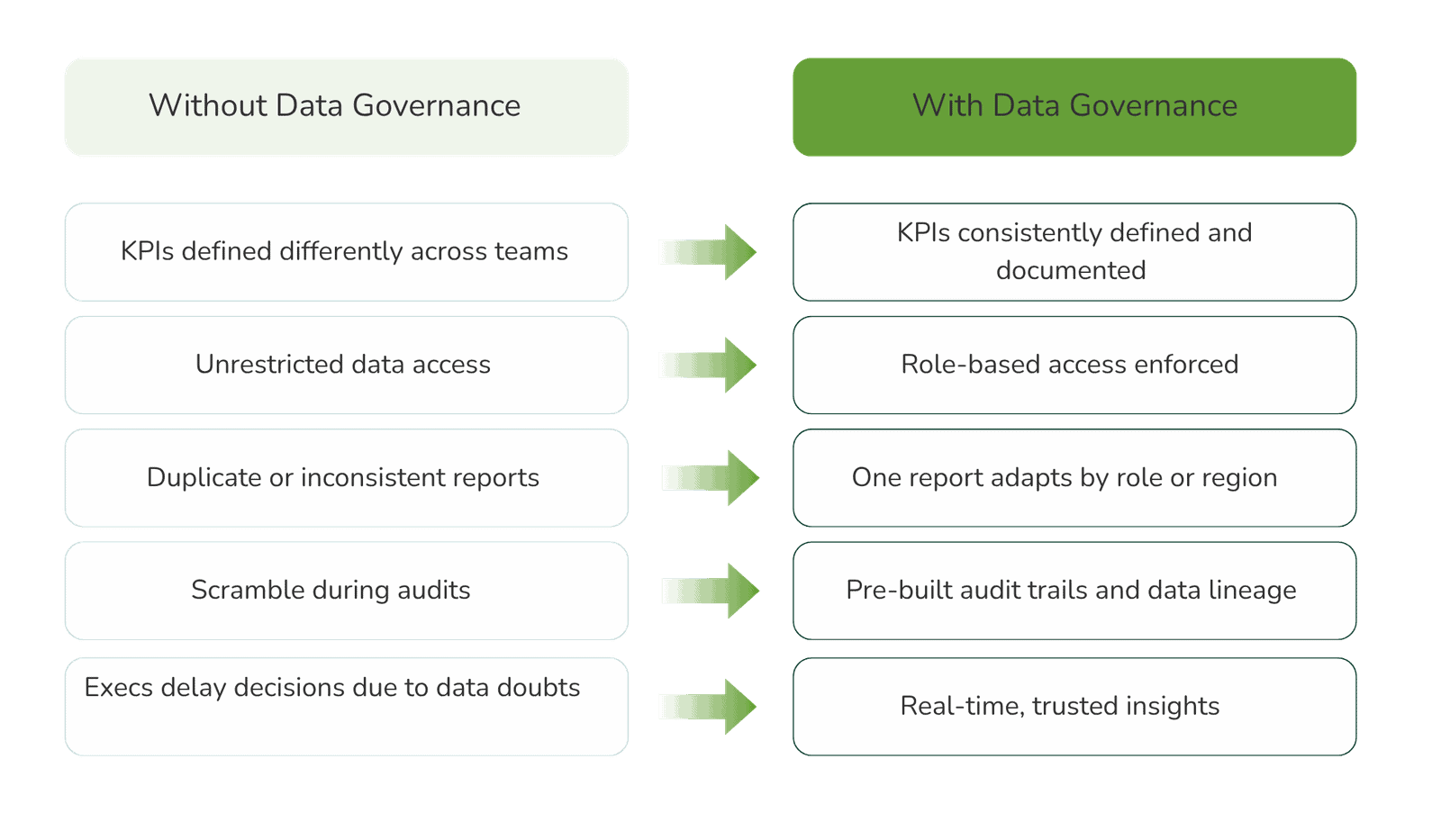
One of our clients had the same KPIs being used by different departments, but each department had its own definition and calculation method. This resulted in the same KPI name showing different values across reports, which caused confusion at the management level. The problem arose because the departments didn’t align on the definitions, even though both values were technically correct for their specific contexts.
By implementing data governance, we helped the client define and document top-level KPIs for the company and each department. With a clear, unified understanding of what each KPI means and how it should be calculated, the client was able to ensure consistent reporting and eliminate confusion.
Takeaway:
Start with business-critical KPIs. Define their formulas, source systems, and owners. Publish and maintain them centrally.
2. Regulatory Compliance & Risk Reduction
Laws like GDPR require companies to know where their data is, how it’s used, and who has access.
Compliance pressure is rising further with the EU AI Act. Article 10 sets out specific data governance requirements for high-risk AI systems, covering how training, validation, and testing datasets are sourced, prepared, checked for bias, and documented. Obligations become enforceable from 2 August 2026, with penalties run up to €15 million or 3% of global turnover for high-risk system non-compliance (such as Article 10 data governance failures), and up to €35 million or 7% for prohibited AI practices.. Businesses building or deploying AI in scope of the Act need to treat data governance as the mechanism that makes AI Act compliance provable.
Takeaway:
Map your data lifecycle and identify high-risk data early. Automate documentation where possible.
3. Improved Data Security & Access Control
Data security is a growing concern. With proper governance, sensitive data is protected through role-based access controls, preventing unauthorised access and reducing the risk of data leaks.
Takeaway:
Implement role-based permissions to ensure that only authorised personnel have access to sensitive data, reducing the chance of breaches.
4. Increased Operational Efficiency
Data governance reduces the time spent cleaning and managing data. Employees can trust the data they use, as it is consistent and accurate. This not only improves individual productivity but also streamlines collaboration between departments.
Example from our practice:
One of our clients faced challenges with managing multiple reports tailored to different departments. Each department needed similar data but with slight variations depending on user roles. This led to the creation and maintenance of multiple reports, each requiring updates and corrections, causing significant overhead. By implementing row-level security (RLS) and column-level security (CLS) within the data platform and the dashboarding tool, we were able to consolidate these reports into a single dynamic report. Now, each department can access the same report, but the data changes depending on the user’s role and permissions. This eliminated the need for redundant report creation, significantly reducing maintenance time while improving operational efficiency.
Takeaway:
Make use of RLS and CLS to manage access control at a granular level. This allows you to maintain fewer reports while ensuring users only see the data relevant to them, reducing the risk of errors and improving efficiency across your business.
Organisations managing an ERP implementation will find that data governance is often a prerequisite for clean, reliable migration data.
5. Better Decision-Making with Reliable Data
Inconsistent data stalls decision-making. With strong governance, executives don’t have to question whether numbers are reliable.
Reliable data is also critical for predictive models and AI. Without consistent inputs, your models will generate noise instead of insight.
Takeaway:
Build trust in your data first, before building advanced analytics or AI models.
6. Scalable Infrastructure as Your Business Grows
As your business grows, so does the amount of data you manage. Data governance ensures that data remains structured and scalable, supporting business expansion and digital transformation initiatives such as cloud migration.
Takeaway:
Implementing data governance helps businesses scale by providing a solid foundation to manage increasing data complexity and future growth.
7. Competitive Advantage & Data Monetisation
Optimising the use of data can be a competitive edge. With data governance, businesses can reduce costs and even monetise their data. For instance, when your data is clean and reliable, you can:
- Build better customer profiles
- Sell anonymised insights (in compliant ways)
- Create more personalised products
A well-governed data estate also provides the foundation for a modern data warehouse, where clean, trusted data can be queried at scale.
Takeaway:
Use governance to drive innovation, improve customer experiences, and create new revenue streams by using insights gained through proper governance.
8. AI That Actually Works: Governance Is the Prerequisite
Most AI and analytics projects fail because the data feeding the model is inconsistent, duplicated, or undocumented. The model learns those flaws and repeats them at scale.
Governance defines where training data comes from, how it is cleaned and validated, who is accountable for its quality, and how bias and gaps are checked before a model reaches business decisions. This is the same discipline the EU AI Act now requires for high-risk systems under Article 10.
Businesses building on Databricks or Microsoft Fabric should treat this as infrastructure work, funded and planned like the rest of the platform build. Eunoia’s AI integration services establish governance first, then build models on top of it.
Takeaway:
Build predictive models and AI features on governed data. Establish data ownership and validation before model work starts.
9. Reduced Data Duplication and Storage Cost
Without governance, the same data tends to get copied, reshaped, and stored multiple times across departments, each team building its own version because nobody trusts, or can find, the source of truth. That duplication has a direct cost: more storage, more compute spent on redundant pipelines, and more engineering hours spent reconciling numbers that should never have diverged in the first place.
Governance addresses this by establishing a single, documented source for each dataset and metric, with clear ownership over where it lives and who maintains it. Teams pull from the same governed source instead of recreating it. This applies the same row-level and column-level security principle described under Operational Efficiency, moved from the reporting layer to the data storage layer.
Takeaway:
Audit for duplicate datasets and reports before adding new storage or compute. Governance usually finds savings before it finds new spend.
10. Faster Onboarding for New Analytics Initiatives
Every new analytics or AI initiative begins by re-establishing what data exists, what it means, and whether it can be trusted. In ungoverned organisations, that groundwork gets rebuilt from scratch each time, often consuming weeks before real project work starts.
With governance in place, that groundwork already exists. Data stewardship, KPI definitions, access rules, and lineage documentation are established once and reused across every subsequent project. New initiatives move directly to analysis and delivery, with less time spent re-establishing what the data means each time a project starts.
Takeaway:
Treat your governance framework as reusable infrastructure. The second and third analytics project stand up faster than the first.
How to Implement Data Governance in Your Business
Here is step-by-step process that will lead you to successful implementation of data governance framework:
- Set your goals – Is it compliance? Operational efficiency? Trust in reporting?
- Assign ownership – Designate data stewards and KPI owners.
- Define policies – For naming, access, retention, and documentation.
- Choose tools wisely – Use platforms with governance baked in (e.g. Azure, AWS, Databricks).
- Train the org – Embed governance into onboarding and project delivery.
- Monitor and adapt – Treat governance as a living system – not a one-off project.
Final Thoughts
The benefits of data governance are tangible: cleaner data, faster reporting, reduced risk, and scalable infrastructure.
Whether you’re preparing for an IPO, preparing for new regulation, or tired of slow, error-prone reports, strong governance can help.