Most organisations invest in AI without a coherent data and AI strategy, and the results show: fragmented initiatives, poor data quality, and tools that never deliver measurable value. This guide draws on Eunoia’s direct experience working with organisations across industries to identify the five most common failure points and offer a practical seven-step framework for addressing them. The steps cover defining clear business objectives, establishing a data-driven culture, building scalable architecture, prioritising governance and security, selecting high-impact AI use cases, investing in partnerships, and measuring progress against defined KPIs. Companies that get this right see compounding returns: Accenture research cited in this article shows that differentiated AI strategies have delivered a 3x increase in shareholder returns over five years.
A robust Data and AI strategy is not just an advantage—it’s a necessity. Organisations across industries are recognising that the ability to derive actionable insights from data and leverage AI-driven capabilities can drive unprecedented growth, efficiency, and innovation. However, crafting an effective strategy requires more than just technology investment. It demands a holistic approach that integrates vision, culture, and execution. Struggling with AI progress despite big investments?
Learn to build a data and AI strategy that drives real results.
Aligning business goals with AI initiatives is critical to achieving measurable success. Accenture found that companies successfully pursuing AI-fuelled reinvention have delivered topline performance that outperforms their peers by 15%. By 2026, this revenue growth gap is expected to more than double to 37%. Additional Accenture analysis indicates that companies with differentiated AI strategies operationalised for value experienced a 3x increase in total return to shareholders over a 5-year period.
Why Data and AI Strategies Often Fail, Our Experiences in the Market
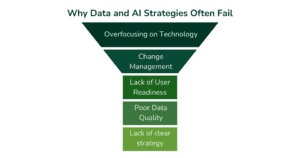
At Eunoia, we’ve worked with numerous organisations across industries, and we’ve observed several common challenges that hinder the success of Data and AI strategies:
Lack of Clear Goals
Many organisations start their AI journey without a well-defined purpose. This often leads to fragmented efforts and investments in solutions that fail to deliver measurable value.
Poor Data Quality
Clean, reliable data is the foundation of any AI initiative. We’ve seen projects significantly delayed or derailed due to double entries, inconsistent formats, or missing data.
Lack of User Readiness
Even the most advanced AI models can fail to deliver impact if the intended users lack the skills or training to interpret and act on the insights provided. User adoption and readiness are critical for success.
Overlooking Change Management
Organisations sometimes underestimate the cultural and operational changes required to implement AI solutions effectively. This can result in resistance or underutilisation of the technology.
Focusing Solely on Technology
We’ve seen businesses invest heavily in cutting-edge tools without considering their business processes or aligning with strategic objectives, leading to wasted resources. Aligning systems is critical. If you’re tackling legacy system migration, check out how Hudson Holding Group successfully migrated to a modern data platform..
While these challenges may seem daunting, they also present opportunities to design better frameworks and roadmaps for success. By addressing these pain points with clear objectives, robust processes, and a focus on collaboration, businesses can unlock the true potential of their data and AI investments. Below are key steps to building an effective Data and AI strategy:
Define Clear Business Objectives
The foundation of any data and AI strategy is alignment with business goals. Whether it’s improving customer experience, optimising operations, or exploring new revenue streams, clarity in objectives ensures that data initiatives deliver tangible value. Engage cross-functional leaders early to ensure alignment and commitment.
Establish a Data-Driven Culture
A successful strategy transcends technology—it’s about people. Foster a culture where decisions are driven by data, not intuition. Invest in training and upskilling teams to be comfortable interpreting and leveraging data insights. Celebrate successes that come from data-driven decisions to reinforce this mindset.
Build a Scalable and Flexible Data Platform

Your data architecture should be future-proof and adaptable. Embrace modern technologies like cloud platforms, Delta Lake, or hybrid data solutions that enable seamless scaling, efficient data processing, and integration with AI models. Adopting a Medallion architecture (bronze, silver, gold layers) can simplify data engineering and ensure high-quality data pipelines. Learn more about building modern data infrastructure.
Prioritise Data Governance and Security

With data as a strategic asset, governance and security are non-negotiable. Implement robust data governance policies to ensure accuracy, consistency, and compliance with regulations like GDPR or CCPA. Address security concerns by encrypting sensitive data and employing access controls.
Focus on Strategic AI Use Cases
AI implementation should not be about chasing trends but solving meaningful business problems. Begin with high-impact, quick-win use cases—like predictive maintenance, customer segmentation, or demand forecasting. Success in these areas builds momentum and trust in AI initiatives.
Invest in Collaboration and Partnerships

Collaboration accelerates innovation. Partner with technology providers, academic institutions, or startups to stay ahead of the curve. Platforms like Databricks or Microsoft Fabric offer integration capabilities that maximize your AI potential while supporting scalability.
Measure, Optimise, Repeat
A strategy is only as good as its execution. Set clear KPIs to measure progress and impact. Continuously refine your approach based on results, new opportunities, and evolving business needs.
These lessons highlight the importance of a balanced approach that combines technical expertise with organisational readiness and strategic clarity.

Final Thoughts on AI and Data Strategy
At Eunoia, we’ve seen firsthand how a well-executed Data and AI strategy can transform businesses. To explore the impact of such a strategy, take a look at how we helped NetRefer, an affiliate marketing platform provider, achieve data and AI transformation:data and AI transformation of NetRefer, affiliate marketing platform provider.It’s about creating a roadmap that balances immediate wins with long-term vision – all while keeping your organisation agile and prepared for the future.
Build a strategy that not only meets today’s demands but sets the stage for tomorrow’s innovations.
A data and AI strategy is a structured roadmap that defines how an organisation will collect, manage, and use data to drive AI-powered capabilities and business outcomes. As this article explains, an effective strategy goes beyond technology investment — it requires alignment with clear business objectives, a data-driven culture, robust governance, and a realistic plan for user readiness and change management. Without these elements, even significant AI investments tend to produce fragmented efforts and limited measurable value.
How do you build an effective data and AI strategy?
As outlined in this article, building an effective data and AI strategy involves seven key steps:
(1) defining clear business objectives aligned with AI initiatives;
(2) establishing a data-driven culture across the organisation;
(3) building a scalable and flexible data platform using modern architectures like Medallion (bronze, silver, gold layers);
(4) prioritising data governance and security to ensure data accuracy and regulatory compliance;
(5) focusing AI efforts on high-impact, quick-win use cases such as predictive maintenance or customer segmentation;
(6) investing in collaboration with technology partners; and
(7) measuring progress against defined KPIs and continuously refining the approach.
Why do data and AI strategies fail?
Based on Eunoia’s direct experience working with organisations across industries, the most common failure points are: a lack of clear goals that ties AI investments to measurable business outcomes; poor data quality (double entries, inconsistent formats, missing data) that undermines AI model reliability; insufficient user readiness, where teams lack the skills to act on AI-generated insights; underestimating change management requirements; and focusing solely on technology without aligning with business processes or strategy. Each of these failure points is addressable, but only if recognised and planned for from the outset.
What are the key components of a data and AI strategy?
The key components of a data and AI strategy, as described in this article, are: clear business objectives that define what success looks like; a data-driven culture that embeds analytical thinking across teams; a scalable data platform capable of integrating modern tools and AI models; data governance and security policies that ensure data accuracy and regulatory compliance; a prioritised portfolio of AI use cases focused on solving real business problems; strategic partnerships with technology providers; and a performance measurement framework of KPIs that enables continuous improvement.
How do you align AI strategy with business goals?
Aligning AI strategy with business goals begins with engaging cross-functional leaders early, before technology decisions are made, to ensure that data initiatives are designed around measurable business outcomes rather than technical capability alone. As Accenture research cited in this article demonstrates, companies that successfully pursue AI-fuelled reinvention outperform peers by 15% on topline performance. The mechanism is deliberate alignment: AI use cases are selected because they address specific business problems (improving customer experience, optimising operations, generating new revenue), not because the technology is available.
Keith Cutajar
Author
Keith manages operational processes and leads Eunoia’s client engagements on data and AI strategy. Drawing on hands-on experience working with organisations, he helps businesses identify the root causes of stalled AI initiatives and build practical roadmaps that deliver measurable results.
Manage Consent
To provide the best experiences, we use technologies like cookies to store and/or access device information. Consenting to these technologies will allow us to process data such as browsing behavior or unique IDs on this site. Not consenting or withdrawing consent, may adversely affect certain features and functions.
Functional
Always active
The technical storage or access is strictly necessary for the legitimate purpose of enabling the use of a specific service explicitly requested by the subscriber or user, or for the sole purpose of carrying out the transmission of a communication over an electronic communications network.
Preferences
The technical storage or access is necessary for the legitimate purpose of storing preferences that are not requested by the subscriber or user.
Statistics
The technical storage or access that is used exclusively for statistical purposes.The technical storage or access that is used exclusively for anonymous statistical purposes. Without a subpoena, voluntary compliance on the part of your Internet Service Provider, or additional records from a third party, information stored or retrieved for this purpose alone cannot usually be used to identify you.
Marketing
The technical storage or access is required to create user profiles to send advertising, or to track the user on a website or across several websites for similar marketing purposes.