
Top 10 RPA Use Cases in Banking Industry in 2026

Updated:
Apr 23, 2026
Identifying high-impact RPA use cases in banking is critical for modernisation. Our team has worked with large banks on automation pilots, and we see that opportunity for RPA within financial institutions is huge.
Many banks struggle with manual, repetitive work to move data between legacy systems, complete KYC checks or process loan applications. With so much of operational work on an ongoing basist is hard to respond to growing customer expectations and be agile enough to innovate for advantage in the market competition. By automating processes, banks can achieve higher efficiency and scale operations where it will add value to them.
What matters most when automating processes is choosing the right use case, as not every workflow delivers the same impact, and results can vary widely between organisations, especially across different industries.
In this article, we focus on the top 10 RPA use cases in banking sector for 2026, giving you a clear view of where the industry is heading and which areas are attracting the most attention.
Why RPA matters now in banking operations
Many banks still run critical processes – onboarding, KYC and compliance reporting – on legacy systems that depend on manual data entry and constant switching between multiple applications. This slows everything down, increases the chance of mistakes, and makes it difficult to scale. For example, we routinely see onboarding teams retyping information from scanned documents into separate KYC, CRM and core banking tools, or credit officers manually comparing uploaded bank statements against internal templates.
From our team’s experience, when a process is repeatable and can be documented, it can be automated. Software bots follow the same steps a user would take – opening systems, copying data, checking fields, applying rules – but far faster and without the inconsistencies that come with manual work. In one recent project, an RPA bot processed loan application documents, extracted key data and uploaded tagged files directly into a legacy platform, lowering processing time from hours to minutes. That consistency improves both operational efficiency and compliance readiness.
Because RPA bots work across existing systems, even those no longer supported or easily integrated, banks can begin automating without replacing their core infrastructure. After reviewing their data estate, many institutions also identify improvements to their data management as a natural next step, opening further automation opportunities, including document intelligence and LLM-driven analysis.
Frequently, banks want to strengthen control over how their data is structured, validated and maintained and in this case data governance can be used. You can read more in our guide on data governance in banking.
10 Key RPA Use Cases in Banking
 Customer Onboarding and KYC / AML
Banks receive identity documents, address proofs, signatures and all these files need validation. Done manually, the amount of work is enormous.
Bots can independently extract data, validate documents against watchlists or internal databases, and populate core systems. Apart from reducing manual effort, it lowers the level of mistakes in data entry.
“How to trust it?” – you might wonder. Every step taken by the bot is logged and users can review boundary boxes or extracted fields before confirming. This level of visibility keeps the process transparent and gives teams confidence that the checks are correct.
Financial institutions implementing intelligent automation went from 15-20 minutes to 3-5 minutes per application, while maintaining accuracy rates above 95%.
 Loan and Credit Underwriting
Loan applications require data collection, credit-history verification, document validation, often across multiple systems. RPA handles the repetitive parts reliably.
For example, bots can gather applicant data, pull credit scores, compile documentation, and generate reports ready for human review.
 Mortgage and Document-Intensive Lending Workflows
Mortgage processing generates many documents: income proofs, collateral valuations, property reports, etc. With robotic process automation, you can extract key data and update internal systems.
That leads to faster processing cycles, fewer manual errors, and better record-keeping.
 Regulatory Reporting & Compliance
Banks need to compile data from multiple sources – internal systems, external feeds – to populate compliance reports. RPA bots can aggregate, standardise and compile these automatically.
Because bots are consistent and trace every action, they create logs that later can be used for audit, essential under regulatory pressure.
 Fraud Detection and Risk Monitoring
Bots can monitor transactions or data flows for predefined risk indicators, flagging anomalies in real time instead of relying on periodic manual checks.
That speed helps risk or fraud teams react sooner, reducing potential losses or compliance issues.
 Accounts Payable, Reconciliation & Payments Processing
Handling vendor invoices, reconciling payments and posting to ledgers often involve manual matching of data. This a repeatable and error-prone task. RPA handles this reliably.
Bots extract invoice data (sometimes using OCR), match with purchase orders or ledger entries, and trigger payment scheduling, saving time and reducing mistakes.
 Internal Audit, Ledger Maintenance and General-Ledger Workflows
Many internal audit and ledger update tasks follow strict rules and are repetitive. RPA ensures they run consistently, and every step is recorded.
That reduces risk of errors or oversight and supports regulatory or audit readiness.
 Customer Service & Back-Office Support
For routine queries, like account balance checks, status updates, and basic requests – bots can collect data and update systems without human intervention.
For banks with high call volume or many support requests, this cuts response times and frees human agents for complex issues.
 Credit Card Processing and Lifecycle Events
Card issuance, re-issuance, blocking, renewal – the rules are pre-defined, and there are repetitive tasks in the process. In these cases, robots will be effective at handling them independently and even reduce number of mistakes.
That helps banks maintain consistency and speed up customer service cycles without unnecessary manual work.
 Treasury Operations, Fund Transfers and Payment Settlements
Treasury functions often involve large volume transactions, liquidity checks, inter-account transfers – all needing accuracy and timeliness. RPA bots can automate these recurrent tasks reliably.
This helps with cash-flow management, compliance reporting and reduces operational risk around settlements.
Example From Practice: Legacy Workflow Automation
From a client project, we handled a legacy-system process where staff had to manually upload documents to SharePoint and then re-input data into a bank’s core system.
We used low-code automation to detect uploads automatically, extract data via OCR (for example addresses or loan values), and send structured data to the core platform. We also built a module to flag potentially risky transactions, for example suspicious entries in bank statements during loan application checks. That meant fewer errors, faster processing and much better visibility of risk.
The result: a noticeable drop in manual workload and much improved processing times. It also highlighted that even legacy systems, long considered too rigid for automation, can benefit from RPA when the process is clearly defined.
What Banking Leaders Should Watch Out For in 2026
RPA brings clear advantages, but only if implemented with strategy in mind. From our experience, it’s critical to maintain transparency over what bots do. This helps smoothing compliance and simply brings confidence in the output.
That’s why we recommend building audit trails, tracking decision points and ensuring bots operate within control frameworks.
It also matters to choose processes that are stable rather than constantly changing, because bots work best when rules are clearly defined and unlikely to shift often.
Combining RPA with Document Intelligence and AI
Traditional RPA works best when tasks are structured and rule based. But many banking processes involve
unstructured or semi-structured data – scanned documents, free-form notes, emails.
Advanced automation stacks – combining RPA with document-intelligence tools (e.g. OCR) and, increasingly, AI or LLM-based interpretation – make it possible to handle those complex tasks. Bots can extract information from scanned documents, interpret context, and feed structured outputs into core systems.
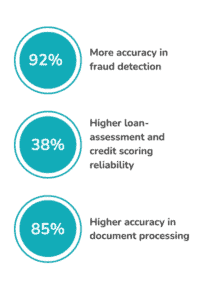
What is more, the combination of RPA with machine learning algorithms has enabled predictive analytics capabilities that identify potential fraud patterns with 92% accuracy, representing a significant improvement over traditional detection method. The same report discovered that AI-supported RPA reaches around 38% higher accuracy in loan processing and credit assessment when compared with traditional rule-based automation. Natural Language Processing has shown strong results in document processing, with some implementations reaching around 85% accuracy when extracting key information from unstructured files such as loan applications and supporting documents.
The efficiency of automation powered by AI is growing and banks that adopt this combined approach stand to gain sustained improvements in efficiency, control and scalability.
Conclusion
RPA provides banking institutions with a practical and achievable way to reduce manual work, raise accuracy and meet compliance demands, without needing to overhaul core systems.
By picking the right tasks, especially those that are repetitive, rule-based and stable, banks can see real returns quickly. And with proper governance and auditability, automation becomes a reliable backbone for operations.
As automation technologies evolve, combining RPA with document intelligence and AI opens additional opportunities, making processes that once seemed too complex for automation more manageable and controllable.
If your bank is still relying heavily on manual workflows, now is the time to consider where RPA can help.
Why the data foundation behind your automation matters?
If your bank is reviewing how systems, teams and data structures fit together, this guide outlines what a mature data environment looks like and where gaps usually appear.
Use case of AI for business intelligence
If you’re exploring how modern tech can enable new opportunities for your business, this piece helps you understand what banks can do to gain competitive advantage in the digitalisation pace.

Keith Cutajar, COO, Data Engineering Expert
Author
Keith Cutajar is Chief Operating Officer at Eunoia, bringing over eight years of hands-on experience leading data and AI transformation projects.
He has overseen end-to-end implementations across cloud platforms like Azure and Databricks, with a focus on turning complex data systems into real business outcomes.
Keith holds multiple certifications in Microsoft Fabric, Azure, and Databricks, and has led cross-functional teams through platform migrations, AI deployments, and analytics modernisation initiatives.
His track record positions him as a trusted voice for organisations looking to operationalise data at scale.